
- India’s Demographic Advantage: Unlocking Potential
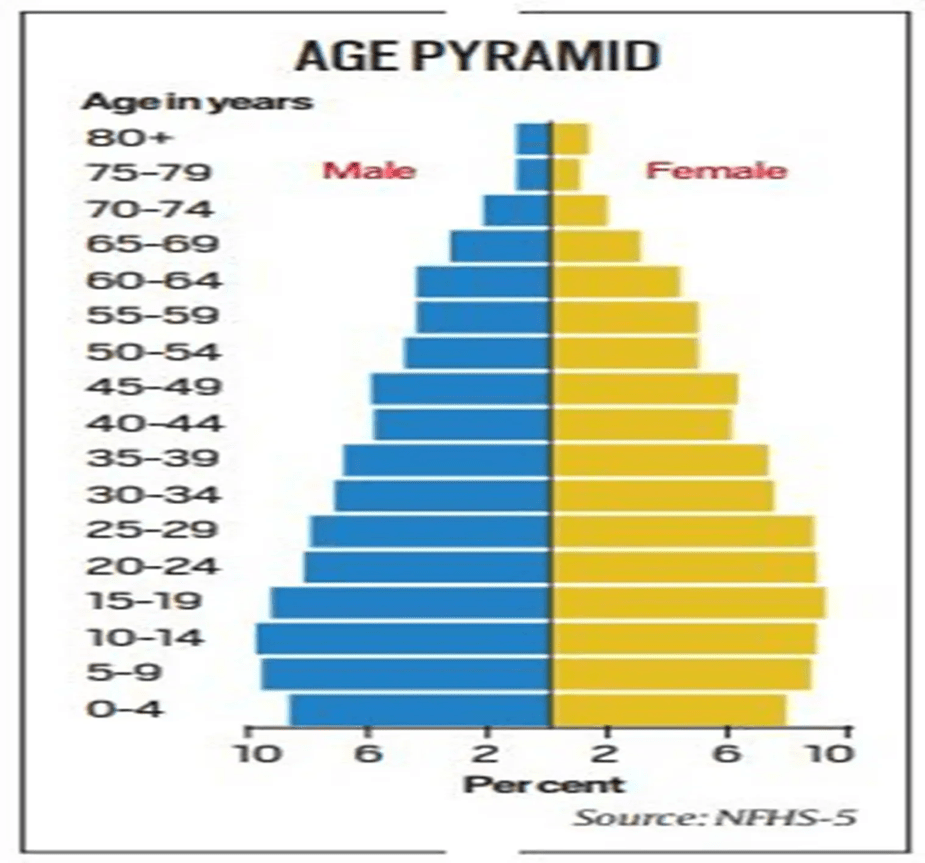
India is home to the world’s largest youth population, with over 50% of its 1.4 billion citizens under the age of 25. This offers a unique opportunity for the country to leverage its demographic dividend by expanding and upgrading its education system.
- Population Under 25: 600+ million
- Median Age: 28 years
This youthful workforce requires skill development and higher education to meet the demands of future jobs, which are increasingly driven by technological advancements. India must enhance its education system to prepare its young population for the evolving global economy.
Graph 1: Age Distribution of India’s Population
2. Expanding Higher Education Capacity
India has made substantial progress in higher education. The country boasts 1,100+ universities and 42,000+ colleges, but the Gross Enrollment Ratio (GER) in higher education remains at 27.1% (2021), which is below the global average of 40% (data from Time Higher Education Network)
To meet the growing demand for higher education, India has set a target GER of 50% by 2035, in line with the National Education Policy (NEP) 2020. This presents a significant opportunity for private and international players to invest in India’s higher education sector.
- Current GER: 27.1% (2021)
- Target GER: 50% by 2035
- Technology-Driven Transformation in Education
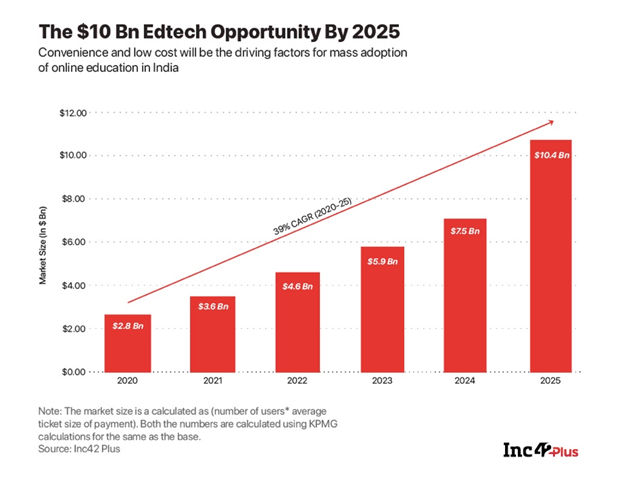
The rise of digital platforms, EdTech startups, and online education has revolutionized learning in India. The EdTech market in India is projected to grow to $10.4 billion by 2025, up from $2.8 billion in 2020, reflecting the shift toward hybrid and online learning.
Key initiatives in this area include:
- SWAYAM: India’s massive open online courses (MOOCs) platform, providing over 2,000+ courses to millions of students.
- National Digital Library of India: Offering access to 4.6 million+ resources for students and researchers.
Graph 2: Growth of EdTech Market in India (2020-2025)
4. Internationalization and Global Collaborations
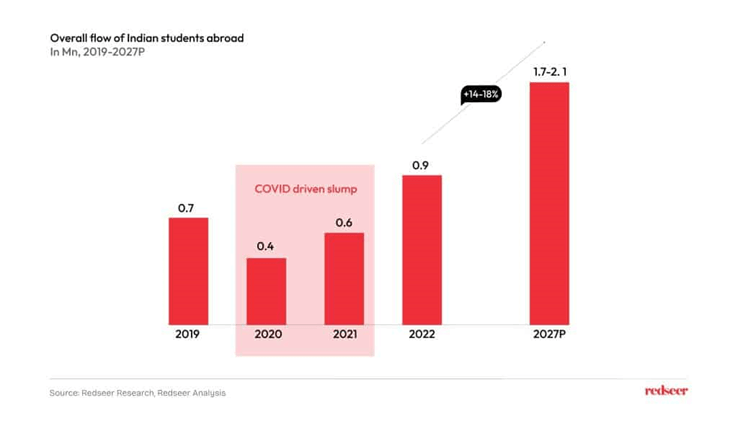
With over 1 million Indian students studying abroad each year, India has been a leading source of international students. To reverse this outflow, the country is working to create world-class educational infrastructure at home, attracting not only Indian students but also international learners.
The Study in India program, launched by the Indian government, aims to attract 200,000 foreign students by 2025. This initiative, alongside efforts to improve university rankings and research capabilities, positions India as a growing hub for international education.
- Indian Students Abroad: 1 million+
- Target Foreign Students by 2025: 200,000
Graph 3: Indian Students Studying Abroad
5. Skill Development and Vocational Education
India’s ambitious Skill India Mission aims to train over 400 million people by 2025. The focus is on equipping the youth with skills required in emerging industries such as IT, manufacturing, healthcare, and renewable energy. Additionally, vocational training and apprenticeships are being integrated into the education system to meet industry needs.
- Skill India Target: 400 million by 2025
- Jobs Created in IT & Manufacturing: 5 million (expected by 2025)
- Policy Support and Public-Private Partnerships
The National Education Policy (NEP) 2020 has been a game-changer for India’s education sector, focusing on flexibility, interdisciplinary learning, and the integration of technology. It encourages public-private partnerships (PPP) and international collaborations to build world-class educational institutions.
- Focus Areas: Skill development, digital education, flexibility in curriculum
- Target: India as a $313 billion education market by 2030
Several states, including Karnataka, Maharashtra, and Tamil Nadu, have already implemented PPP models to expand higher education infrastructure, with favorable government policies encouraging investment in education.
- R&D and Innovation in Universities
India is focusing on expanding research output through initiatives like the National Research Foundation (NRF), which seeks to increase R&D funding and output. The goal is to ensure that universities focus on research, innovation, and entrepreneurship, enabling them to contribute to key sectors such as healthcare, agriculture, and AI.
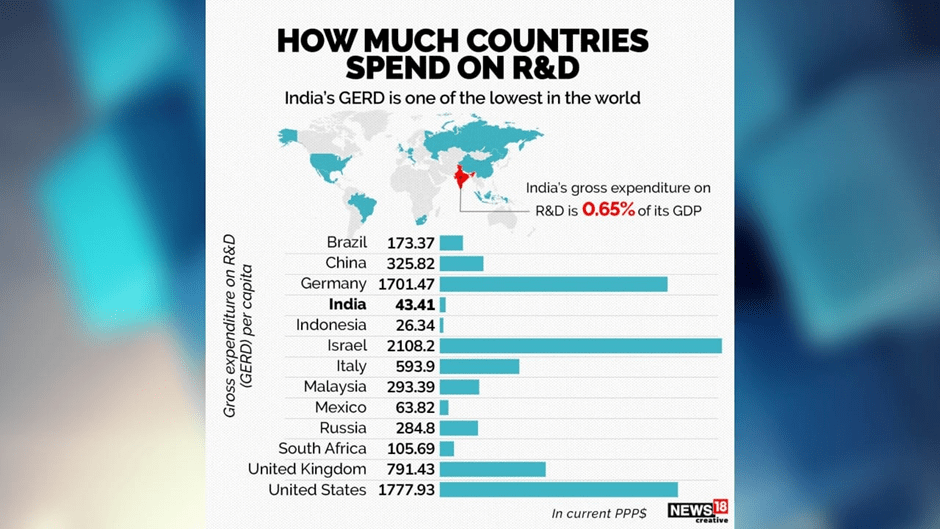
- Current R&D Spend: 0.7% of GDP (2023)
- Target R&D Spend: 2.0% of GDP by 2030
India’s universities are encouraged to collaborate with industries and global institutions to foster innovation and solve local challenges through research.
Graph 4: R&D Expenditure in India
8. Economic Impact and Return on Investment
The rapid expansion of higher education and skill development will have far-reaching economic impacts. The education sector in India is expected to contribute $313 billion to the national GDP by 2030. This growth will create millions of jobs, boost productivity, and attract foreign investment.
- Expected Education Sector Size: $313 billion by 2030
- Employment Growth: 6.5 million jobs by 2025
Investments in higher education, research, and skill development are expected to yield a high return on investment (ROI) through increased labor productivity, improved innovation, and the creation of a highly skilled workforce ready for future jobs.
Conclusion
The potential for growth in India’s education sector is immense, with significant opportunities for public-private partnerships, international collaboration, and technological advancement. By 2030, India’s education sector is poised to be a major driver of its economic and social development, unlocking new frontiers in global competitiveness.
References:
- Youth Demographics:
- United Nations Population Division: World Population Prospects 2022.
- Census of India 2011; projections for 2023.
- Indian Express – Half of India’s population under age 30
- Higher Education Institutions and GER:
- All India Survey on Higher Education (AISHE) 2021-22.
- Ministry of Education, Government of India.
- https://www.stantonchase.com/insights/white-papers/future-forward-a-roadmap-for-growth-and-transformation-in-indian-higher-education
- EdTech Market Growth:
- Report by RBSA Advisors on Indian EdTech Industry, 2021.
- NASSCOM and RedSeer EdTech Report 2022.
- https://inc42.com/datalab/the-future-of-education-indian-startups-chase-10-bn-edtech-market/
- International Students and Study in India Initiative:
- Ministry of Education, Government of India, “Study in India” portal and program details.
- UNESCO Institute for Statistics (UIS) on International Student Mobility.
- https://redseer.com/newsletters/the-shifting-landscape-of-study-abroad/
- Skill Development and Vocational Training:
- National Skill Development Corporation (NSDC) reports.
- Ministry of Skill Development and Entrepreneurship, Government of India.
- Policy Support (NEP 2020):
- National Education Policy (NEP) 2020 document, Ministry of Education.
- Reports by NITI Aayog on the implementation of NEP 2020.
- R&D and Innovation:
- Department of Science and Technology, Government of India.
- Economic Survey 2022-23, Government of India.
- Economic Impact and Education Sector Projections:
- KPMG and Ernst & Young reports on the education sector.
- FICCI-EY report on the future of the education sector in India.
 Invest Punjab Blogs