
As India opens its doors to foreign universities, it stands at the crossroads of an ambitious education transformation. The policy shift to welcome international campuses may appear to be a quick-fix for India’s education quality-quantity gap—but beneath this surface lies a deeper, more compelling opportunity: to participate in a generational effort to reshape one of the world’s largest, youngest, and most aspirational populations.
This is a call to foreign universities: Don’t just come to India. Help build the India of tomorrow.
The Context: A System at a Critical Juncture
India’s higher education landscape is vast but stretched. According to the World Bank, the Gross Enrollment Ratio (GER) in higher education stood at 33% in 2023—starkly lower than 75% in China and 60% in Brazil. For marginalised communities like Scheduled Castes (SCs) and Scheduled Tribes (STs), the numbers are lower still: 25.9%and 21.2% respectively (AISHE Report, 2023).
The reality is clear: millions of Indian students, especially in rural and economically weaker regions, remain excluded from meaningful access to quality higher education. While foreign universities are often associated with exclusivity and high cost, there lies a unique opportunity for them to rethink their model for India—to be not extractive, but transformative.
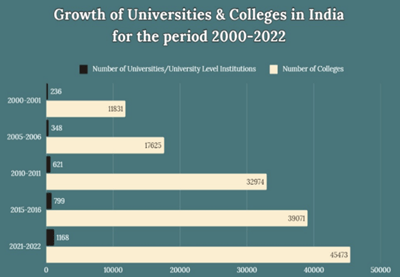
What Foreign Universities Can Learn From India’s Inequality Map
India is not a monolith. While metropolitan cities like Delhi, Mumbai, and Bangalore boast elite institutions and high private education spending, states like Bihar (17.1% GER) and Jharkhand (18.6%) show how deep structural inequities run.
But these are also the states where policy intervention, innovation, and partnerships can yield the highest impact. Foreign universities that partner with state governments, public institutions, and local communities to create satellite campuses, skill-based programs, or blended education models can unlock a largely untapped student base.
From Profit to Purpose: A New Campus Model for India
The traditional model of setting up exclusive, high-cost campuses in urban centers is unsustainable in India—not just financially, but ethically. India’s students and policymakers are looking for inclusive, innovative, and employment-driven models of higher education.

Here are ways forward-thinking foreign institutions can lead:
- Establish Tier-2 and Tier-3 Partnerships: Instead of clustering in metros, set up regional innovation hubs in cities like Indore, Bhubaneswar, Mohali, or Coimbatore. These places offer lower operating costs, government support, and large untapped student populations.
- Build Collaborative Public-Private Programs: Partner with Indian public universities and colleges to offer dual-degree or credit-transfer programs. Public institutions still account for 73.7% of total enrollments—this is the largest pipeline foreign universities can work with.
- Invest in Digital Infrastructure: Hybrid models that combine physical campuses with digital classrooms can widen access without the heavy burden of full-scale infrastructure. This is particularly impactful in rural India.
- Target India’s Skills Gap: India’s employability rate among graduates stands at just 54.81% (India Skills Report 2025), and even lower for vocational graduates. Tailoring curricula toward 21st-century skills, in partnership with industry, could offer immense societal value.
Avoiding the Pitfalls: Lessons from Other Countries
Countries like Singapore, Malaysia, and the UAE have experimented with foreign university campuses—many of which eventually shuttered due to low enrolment, financial strain, and cultural mismatch. Yale-NUS in Singapore and UNSW Singapore are just two cautionary tales.
But India offers something fundamentally different:
- A demographic dividend: Over 50% of India’s population is below 25 years. No other country offers this scale of potential learners.
- A policy push: India’s National Education Policy (NEP) 2020 explicitly encourages internationalization, credit transfer, and cross-border collaboration.
- A digital infrastructure boom: With UPI, Aadhaar, and growing smartphone penetration, India is leapfrogging into education tech and access at scale.
Redefining the Value Proposition for Foreign Universities
India is not simply another overseas market—it is a nation in transformation, with its education system central to its economic, social, and geopolitical ambitions.
Foreign universities that enter India with intent to collaborate, willingness to adapt, and long-term commitment to inclusion can redefine their own legacies.
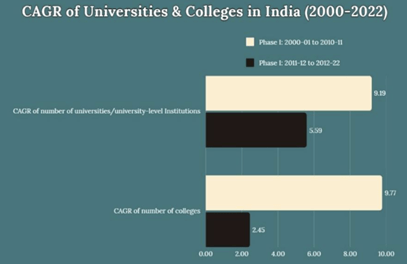
Rather than creating elite islands of education, they can co-create a new education ecosystem that:
- Trains the next 100 million Indian professionals.
- Empowers marginalised students through scholarship-backed access.
- Drives regional innovation through research hubs.
- Creates a global knowledge corridor between India and the world.
Punjab: India’s Gateway for Global Educational Investment
Among India’s many states, Punjab emerges as a frontrunner offering an ideal ecosystem for foreign universities seeking long-term, purpose-driven investment.
Demographic Advantage Meets Global Mindset
Punjab has historically been one of India’s most outward-looking states. It accounts for 12.5% of India’s total overseas student outflow (Beyond Beds & Boundaries Report, 2023). This reflects both a high aspiration for global education and a strong demand for international quality learning within the state.
A foreign university setting up in Punjab would not only attract returnees from abroad, but also stem the brain drain by offering world-class education at home.
Strategic Location & Infrastructure
Located at the intersection of North India’s industrial and agricultural heartland, Punjab offers:
- International connectivity via Chandigarh and Amritsar airports.
- High-speed road and rail corridors connecting to Delhi-NCR, Himachal, and Jammu & Kashmir.
- Access to the Tri-city region (Chandigarh–Mohali–Panchkula), a planned urban zone with a high literacy rate and cosmopolitan population.
Educational Ecosystem with Headroom for Growth
- 40+ universities and 1000+ colleges across disciplines.
- Hosts prominent institutions like IISER, ISB, NABI, and Punjab Agricultural University, creating opportunities for research partnerships, faculty exchange, and joint degrees.
- Government focus on upgrading colleges into centres of excellence, including in AI, data science, sustainability, and agriculture innovation.
Policy Backing & Single-Window Support
The Punjab Government pro actively invites foreign universities to establish campuses in the state’s Education Hubs. Invest Punjab offers single-window clearances, land support, and bespoke facilitation for foreign investments in education.
Cost Advantage with High ROI
Compared to metros, setting up operations in Punjab offers:
- 30–40% lower real estate and operating costs.
- Access to qualified teaching talent from nearby regions like Delhi, Himachal, and Haryana.
- Proximity to a highly aspirational student base from rural and semi-urban Punjab, with a growing demand for quality higher education.
Safe, Green, and Culturally Vibrant
- Punjab is ranked among India’s top states for safety and quality of life.
- Known for its progressive values, inclusive culture, and strong diaspora networks—a natural fit for international collaboration.
Avoiding the Pitfalls: Lessons from Other Countries
Many foreign campuses in the Middle East and Southeast Asia failed due to weak local demand and policy mismatches. But India—and Punjab in particular—offer a robust and resilient ecosystem, backed by youthful demand, government incentives, and global aspirations.
From Profit to Purpose: A New Campus Model for India
Foreign universities must build not just campuses, but outcomes—in skills, jobs, research, and access. Punjab’s model offers the perfect testbed to pilot this new approach.
Imagine a foreign university campus in cities like Mohali that:
- Offers industry-linked degrees in agriculture tech, clean energy, or healthcare management.
- Runs a bi-national research center on climate-smart farming with PAU and EU universities.
- Partners with local colleges to upskill students in Tier-2 districts.
- Uses digital classrooms and mobility programs to widen access across north India.
This is not hypothetical—it’s highly doable in Punjab, today.
Punjab as Your India Strategy
India doesn’t just need foreign universities—it needs committed partners who understand the local potential and global promise. Punjab, with its diaspora-driven demand, proactive governance, and international outlook, offers a compelling entry point.
Foreign universities that begin in Punjab won’t just serve a market—they’ll help shape a model for how global education can drive regional development, equity, and innovation in the world’s most populous nation.
India is not asking for replicas. It’s asking for vision. Are you ready to invest where it truly matters? Start with Punjab.
Conclusion: India Needs Partners, Not Just Campuses
India doesn’t need imported models. It needs partners who are willing to learn as much as they teach, and who measure success not just in dollars, but in development outcomes.
Foreign universities must rise to the occasion—not to serve a narrow elite, but to bridge the real education gap with scalable, inclusive, and mission-driven approaches.
In doing so, they won’t just find a growing market—they’ll find a nation ready to lead the next global education renaissance.
Foreign universities, the question is not whether India is ready for you. The question is—are you ready for the real India?
References and Data Sources
1. Indian Education Landscape
- All India Survey on Higher Education (AISHE) 2020–21 & 2023 (Provisional)
[Ministry of Education, Government of India]
Source: https://aishe.gov.in/- GER for higher education: ~33%
- GER for SCs: ~25.9%, for STs: ~21.2%
- World Bank Education Statistics (EdStats)
[India vs China GER, tertiary education]
Source: https://databank.worldbank.org/source/education-statistics:-all-indicators
2. Indian Student Mobility & Demand for Foreign Education
- “Beyond Beds and Boundaries: Indian Student Mobility Report, 2023”
[University Living & PHD Chamber of Commerce]
Source: https://universityliving.com/blog/wp-content/uploads/2023/07/Beyond-Beds-and-Boundaries.pdf- Punjab, Telangana, and Maharashtra lead in overseas student outflows (~12.5% each)
- Indian students projected to spend $70 billion by 2025 on foreign education
- Ministry of External Affairs, India – Education Abroad Statistics
Source: https://www.mea.gov.in/
3. Punjab as an Investment Destination
- Invest Punjab – Punjab Bureau of Investment Promotion
Source: https://investpunjab.gov.in/- Details on land availability, sectoral policies, and infrastructure
- Single-window clearance & Education Sector opportunities
4. The Wire article
 Invest Punjab Blogs