
India’s healthcare sector stands at a pivotal juncture. Despite years of progress, it faces entrenched challenges—overburdened infrastructure, uneven access, and quality disparities—especially in rural and tier-2/3 geographies. Yet, the convergence of three strategic priorities offers a pathway not just for reform, but transformation: fixing foundational gaps, building capacity for India and the world, and innovating solutions using technology.
By aligning on these themes, healthcare ecosystem participants—governments, private players, insurers, med-tech innovators, and investors—can not only enhance domestic outcomes but also catalyze India’s global leadership in healthcare.

1. Fixing the Gaps: From Sick Care to Preventive, Quality-Centric Systems
a) Emphasizing Preventive Healthcare
India’s system today remains largely reactive. With a growing burden of non-communicable diseases (NCDs), and an aging population, the pressure on tertiary systems is unsustainable. Like Thailand, which pivoted toward preventive health to reduce systemic pressure, India must prioritize:
- Timely diagnosis, lifestyle interventions, adherence to medication, and vaccination as the first line of defense.
- New care delivery models addressing not just medical but also social, behavioral, and therapeutic determinants of health.
- Targeted programs for NCDs such as diabetes and cardiovascular conditions—proven globally to yield better population health outcomes.
b) Quality as a Core Metric
Improving access without improving quality dilutes outcomes. The quality challenge is stark:
- Fewer than 2% of diagnostic labs are NABH-accredited.
- Among 23,000+ hospitals empaneled under PM-JAY, less than 2% meet its prescribed quality standards.
- Adoption of IPHS and NQAS has been limited to a small fraction of facilities.
The solution must lie in:
- Foundational tools to measure, monitor, and improve quality across pharmaceuticals, diagnostics, primary and tertiary care.
- Technology-led interventions that empower clinicians—especially in rural settings—to deliver consistent, evidence-based care.
- Insurance incentives and ecosystem collaboration across providers, payers, pharma, and diagnostics to align on outcomes and not just volumes.
Shifting from “sick care” to “preventive and quality care” is perhaps the single biggest leap India can take in improving medium-term health outcomes.

2. Building Capacity for India and the World
India’s healthcare infrastructure is simultaneously underbuilt for its domestic needs and underleveraged for global opportunities. The country must scale both physical capacity and technical capabilities across the following dimensions:
a) Building for India
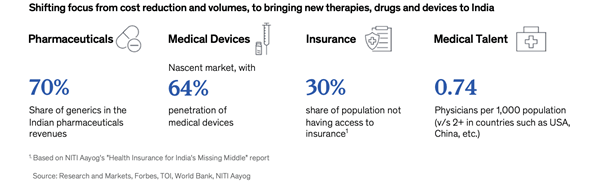
- While India is third globally in pharma volume, it ranks only eleventh by value, indicating limited access to newer, innovative drugs.
- Over 400 million Indians still lack any public or private health insurance coverage.
- Medical device penetration is in early stages, offering a vast opportunity for Indian manufacturing and design innovation.
Opportunities for capacity-building include:
- Developing insurance and care models for the uninsured, including informal sector workers and rural communities.
- Strengthening rural infrastructure via ASHA workers, mobile clinics, telemedicine hubs, and hub-and-spoke models.
- Skilling initiatives to improve the physician and allied healthcare workforce density through widespread access to medical education.
b) Building from India for the World
India’s generics revolution is globally recognized. But the next phase must include:
- Shifting from volume to value in pharma through R&D-led innovation and IP development.
- Scaling med-tech manufacturing, leveraging India’s IT-engineering synergy to develop affordable and novel solutions.
- Expanding medical tourism, which remains confined to a few large hospital chains. With a global reputation for high-quality yet cost-effective care, India can attract far more international patients by integrating:
- End-to-end offerings (medical + hospitality),
- Language and cultural support, and
- Digital concierge systems.
- Global health-tech exports: The Indian SaaS industry grew from $2 billion to $12 billion in a decade and is projected to hit $50–70 billion by 2030. HealthTech can emulate this success, powered by India’s software talent, data capabilities, and policy support.

3. Innovating Healthcare: Technology as a Force Multiplier
India’s 850+ million internet users and expanding digital public infrastructure offer a generational opportunity to redefine care delivery. While programs like Ayushman Bharat Digital Health Mission (ABDM), eSanjeevani, and Apollo TeleHealth have laid early foundations, full-scale adoption of digital health is still in its infancy.
Five Innovation Frontiers:
- Expanding Access and Capacity
- From virtual consults to tele-acute care and remote patient monitoring, digital tools can close the rural access gap.
- Driving Prevention and Chronic Care
- Condition management apps for diabetes, heart disease, and cancer can dramatically reduce hospitalization and cost burdens.
- Reducing Cost-to-Serve
- AI-driven process automation and diagnostics can increase the productivity of talent and physical assets.
- Improving Quality and Experience
- Health systems must integrate quality data collection, real-time monitoring, and AI-assisted decision tools to standardize care.
- Accelerating Innovation
- From AI in drug discovery to new business models tailored to underserved populations, technology can unlock new markets and products.

Conclusion
India’s healthcare challenge is not only a story of under-capacity but of under-ambition. By focusing on:
- Fixing foundational inefficiencies,
- Building capabilities for a dual market—domestic and global, and
- Innovating through technology and partnerships,
India can leapfrog stages of development and create a globally competitive, equitable, and tech-powered healthcare ecosystem.
Investors, policymakers, startups, and large healthcare players all have a role to play. With the right push, India can replicate in healthcare what it has already done in IT, fintech, and space technology—lead not just at home, but across the world.
Reference
McKinsey & Company – Healthcare in India: Opportunities for Growth (November 2023)
https://scaleuphealth.in/wp-content/uploads/2023/11/McKinsey-Company-Healthcare-in-India-Opportunities.pdfConclusion
India’s healthcare challenge is not only a story of under-capacity but of under-ambition. By focusing on:
- Fixing foundational inefficiencies,
- Building capabilities for a dual market—domestic and global, and
- Innovating through technology and partnerships,
India can leapfrog stages of development and create a globally competitive, equitable, and tech-powered healthcare ecosystem.
Investors, policymakers, startups, and large healthcare players all have a role to play. With the right push, India can replicate in healthcare what it has already done in IT, fintech, and space technology—lead not just at home, but across the world.
Reference
McKinsey & Company – Healthcare in India: Opportunities for Growth (November 2023)
https://scaleuphealth.in/wp-content/uploads/2023/11/McKinsey-Company-Healthcare-in-India-Opportunities.pdf
 Invest Punjab Blogs