
India is entering a decisive phase in education reform, guided by the transformative National Education Policy 2020 (NEP 2020). The reforms are designed not merely as incremental changes but as a systemic reorientation of India’s educational philosophy, blending traditional knowledge with modern global standards. This review provides a comprehensive mapping of India’s education roadmap, analysing schemes, institutions, financing mechanisms, research ecosystems, and global partnerships that together propel India’s journey towards becoming a knowledge superpower by 2047, coinciding with its centenary of independence.
1. National Education Policy 2020: The Foundation of Reform
Historical Context
- India’s education policies prior to NEP 2020 (1968 and 1986, with the 1992 modification) were content-heavy, exam-driven, and largely unidimensional.
- NEP 2020 represents the first education policy of the 21st century, emphasizing multidisciplinary learning, vocational integration, digital pedagogy, and internationalization.
Pillars of NEP 2020
- Access: Universalization of education from ages 3–18 through the 5+3+3+4 curricular structure.
- Equity: Focus on socially disadvantaged groups (SC, ST, OBC, minorities, gender, geography).
- Quality: Conceptual learning, experiential pedagogy, flexible curricula, and integration of vocational and arts education.
- Affordability: Financial aid, scholarships, and credit transfer systems to reduce economic barriers.
- Accountability: Transparent governance through National Educational Technology Forum (NETF) and State School Standards Authority (SSSA).
Structural Innovations
- Holistic Multidisciplinary Education: Flexible entry/exit in higher education with Academic Bank of Credits (ABC).
- Teacher Training: National Professional Standards for Teachers (NPST).
- Digital Push: Expansion of DIKSHA, SWAYAM, and blended learning models.

2. School Education: Laying the Foundation for Excellence
(a) NIPUN Bharat Mission
- Launch: 2021 under the Ministry of Education.
- Target: Every child achieves foundational literacy and numeracy (FLN) by Grade 3 by 2026–27.
- Interventions:
- Teacher training modules in local languages.
- Learning Outcomes Dashboard for real-time monitoring.
- Integration with Digital Infrastructure for School Education (DIKSHA).
- Global Benchmarking: Comparable to UNESCO’s Global Education 2030 Agenda (SDG 4).
(b) PM SHRI Schools (Pradhan Mantri Schools for Rising India)
- Launched: September 2022.
- Budget: ₹27,360 crore (2022–27).
- Coverage: 14,500+ schools to act as “lighthouse institutions”.
- Features:
- Digital smart classrooms, AI-enabled labs.
- Emphasis on Indian heritage, arts, yoga, and values.
- Eco-friendly practices (rainwater harvesting, solar power).
- Community linkages: Each PM SHRI school mentors 4–5 neighboring schools.
- Impact: Model for scaling best practices nationwide.
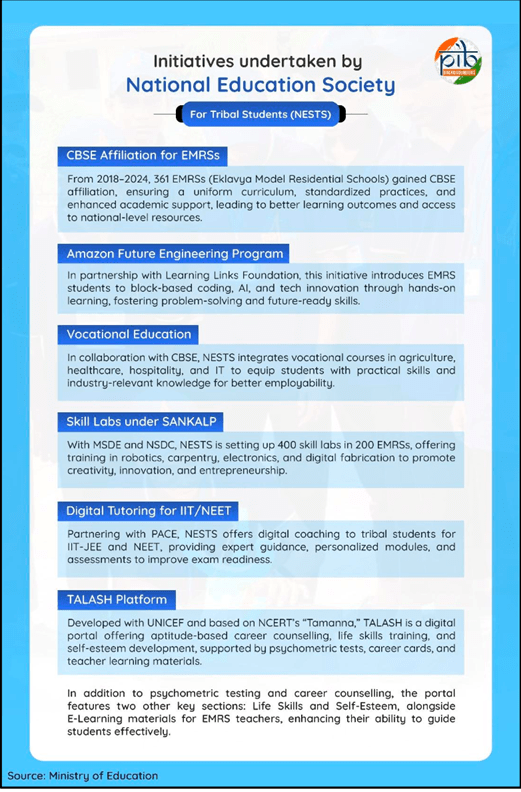
(c) Eklavya Model Residential Schools (EMRS)
- Objective: Address educational exclusion among tribal students.
- Growth: From 123 schools (2013–14) to 477 schools by 2024–25.
- Future Plan: One EMRS in every tribal block with 50% tribal female representation.
- Cultural Relevance: Curriculum incorporates tribal art, language, and traditions, strengthening identity.
3. Accelerated Growth in Higher Education Institutions (HEIs)
| Institution Type | 2014-15 | 2024-25 | Increase | % Growth |
| Higher Education Institutions (HEIs) | 51,534 | 70,683 | 19,149 | 37.2% |
| Universities | 760 | 1,338 | 578 | 76.1% |
| Colleges | 38,498 | 52,081 | 13,583 | 35.3% |
| IITs | 16 | 23 | 7 | 43.8% |
| IIMs | 13 | 21 | 8 | 61.5% |
| AIIMS | 7 | 20 | 13 | 185.7% |
Key Insights
- University growth (76%) indicates India’s push towards regional distribution of higher education.
- IITs & IIMs Expansion: Infrastructure expansion worth ₹11,828.79 crore under IIT Phase-B projects.
- AIIMS Multiplication: Nearly tripled, integrating medical education with telemedicine, research, and outreach.
- Regional Equity: Growth concentrated in Tier-II/Tier-III cities, reducing urban-rural divide in access.
4. Financing Quality Education: Widening Access
(a) PM Vidyalaxmi Scheme (2024)
- Goal: No deserving student is denied higher education due to financial constraints.
- Loan Coverage: Up to ₹10 lakh, subsidized for weaker sections.
- Unique Feature: Special provisions for students excluded from existing schemes.

(b) Central Sector Interest Subsidy (CSIS)
- Eligibility: Families with annual income ≤ ₹4.5 lakh.
- Support: Interest subsidy during moratorium on loans up to ₹10 lakh.
(c) Credit Guarantee Fund Scheme for Education Loan (CGFSEL)
- Guarantee: 75% of education loan up to ₹7.5 lakh.
- Impact: Encourages banks to provide collateral-free loans, reducing dropouts.
5. Infrastructure and Academic Excellence
(a) Higher Education Financing Agency (HEFA)
- Disbursement: ₹21,590.59 crore released (as of 2024).
- Institutions Covered: 106 premier HEIs including IITs, IIMs, IISERs, and Central Universities.
(b) Institutions of Eminence (IoE)
- Concept: 20 institutions (10 public, 10 private) to be globally competitive.
- Autonomy: Academic, administrative, and financial freedom.
- Impact: Accelerated rise in global rankings.
(c) Global Rankings
- QS Rankings: From 13 Indian institutions (2015) to 54 (2026) in top global QS rankings.
- Global Innovation Index: Jump from 76th (2014) to 39th (2024).
6. Specialized Universities: Catalysts of Sectoral Growth
- Gati Shakti Vishwavidyalaya (2022) – India’s first logistics and transport university, with MoU with Airbus.
- Indian Institute of Creative Technology (IICT), Mumbai – Focus on AVGC-XR (Animation, VFX, Gaming, XR).
- National Forensic Sciences University (2020) – World’s first dedicated forensic university with global campuses planned.
7. Nalanda University: Heritage Meets Modernity
- Revival: Symbol of India’s ancient knowledge tradition, re-established in 2010.
- New Campus (2024): Net-zero, powered by solar energy, rainwater harvesting, and green architecture.
- Global Partnerships: Supported by East Asia Summit nations; a hub for civilizational studies, peace, and sustainability.
8. Promoting Research & Innovation: Anusandhan National Research Foundation (ANRF)
- Budgetary Allocation: ₹50,000 crore for first 5 years (2023–28).
- Mandate: Coordinate research, set national priorities, link academia with industry.
- Vision: Develop India into a top-3 global R&D power by 2047.
- Structure: Modeled on NSF (USA) and UKRI (UK).
9. Globalization of Indian Education
- Foreign IITs:
- IIT Madras campus in Zanzibar (2023).
- IIT Delhi campus in Abu Dhabi (2024).
- Study in India Program: Scholarships to attract students from 150+ countries.
- MoUs Signed: With 51 countries for student and faculty mobility.
Conclusion: India’s Path to Knowledge Superpower
India’s reforms represent not just quantitative expansion, but qualitative reorientation:
- Policy Backbone: NEP 2020 as a flexible, holistic framework.
- Equity & Inclusion: Tribal, rural, and marginalized groups prioritized.
- Global Standing: Institutions rising in world rankings, export of education (IIT campuses abroad).
- Research Culture: ANRF, IoEs, and HEFA creating a knowledge-driven economy.
- Future Goal: By 2047, India aims to be among the top 3 global knowledge economies, blending ancient wisdom with modern science.
References
- Ministry of Education, Government of India (AISHE Report).
- NEP 2020 Policy Document.
- HEFA Annual Report.
- PIB Press Releases & Budget 2024–25 Note.
- QS World University Ranking.
- Global Innovation Index Report.
 Invest Punjab Blogs