
WHY MOHALI IS NORTH INDIA’S PREMIER DESTINATION FOR INTERNATIONAL SCHOOLS
As aspirations of India’s middle class continue to rise, education preferences are transforming rapidly. Parents today no longer seek schools that focus solely on academic performance, they want holistic learning, global exposure, and a curriculum that prepares their children for the future. This shift has fueled the growing demand for international education boards such as the International Baccalaureate (IB) and Cambridge (IGCSE). And Mohali stands at the cusp of becoming the next big destination for international schooling in North India.
A Growing National Trend and Untapped Market Potential
Over the past decade, India’s international education landscape has witnessed exponential growth. India now has the second-largest number of international schools in the world, underscoring its growing reputation as a global education hub. Traditionally, international schools have been concentrated in metros like Mumbai, Bengaluru, and Delhi. However, a major shift is underway, Tier-II cities and emerging knowledge destinations are attracting attention due to their better quality of life, affordability, and proximity to talent and infrastructure. This is where Mohali offers a unique advantage
The North India Supply Gap: A Clear Investment Opportunity
According to the International Baccalaureate Organisation and Cambridge International: India currently has 259 IB schools and 1,034 Cambridge-affiliated schools (Source: ibo.org and cambridgeinternational.org). Only 10.4% IB and 21.2% Cambridge schools currently serve North India’s 200+ million population, a clear market undersupply that represents a massive opportunity for new entrants.
Punjab currently has just 11 international-curriculum schools, despite being one of India’s most prosperous states.
Comparatively, states like Maharashtra have 210 and Karnataka 135 international schools, starkly illustrating the North Indian gap and untapped potential.
Tier-II cities and emerging knowledge destinations are attracting attention due to their better quality of life, affordability, and proximity to talent and infrastructure. This is where Mohali offers a unique advantage.
Student-to-School Ratio: For every existing IB/IGCSE school, there are over 70,000 school-age students in North India waiting for quality international education (Internal Analysis based on IBO/Cambridge data).
Rising Global Aspirations Fueling Demand for International Curricula Another major driver of this shift is the rapid increase in Indian student enrollment in foreign universities. According to the Institute of International Education (2024), India is now the number one source country for international students in the United States, surpassing all other nations. Globally, India ranks 26th among the top destinations for international student mobility, reflecting its expanding global education footprint.
A significant portion of these outbound students hail from Punjab, a state with a strong tradition of overseas education and migration. As a result, parents across the region are increasingly opting for IB and Cambridge curricula, which are recognized by top universities worldwide and simplify access, credit transfers, and admissions to institutions abroad.
Top 10 Reasons Why Mohali Stands Out for IB and Cambridge Schools
Mohali offers a unique convergence of factors that makes it the ideal investment location in North India:
- An Ideal Blend of City and Nature
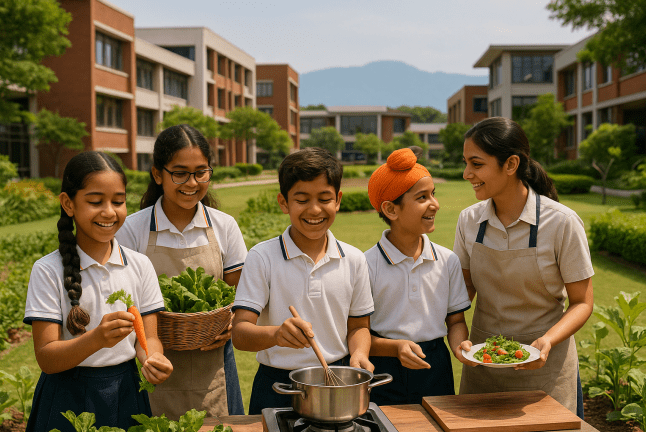
Mohali offers a rare mix of the infrastructure and connectivity of a modern city, along with the calm, clean, and green environment essential for child-centric learning. With its proximity to the Shivalik Hills, open spaces, and pollution-free air, Mohali provides students with opportunities for experiential learning, from farm-to-table initiatives to outdoor classrooms and sports-driven education experiences that are nearly impossible to offer in dense urban environments like Delhi or Mumbai.
- Strategic Location and Connectivity
Located at the heart of North India, Mohali is strategically positioned just hours away from Delhi, Himachal Pradesh, Jammu & Kashmir, and Haryana. This makes it an education magnet for families from these states seeking high-quality schooling without the congestion or high costs of metros. Many border districts in J&K, Ladakh, and even Punjab lack international-standard schools, leading parents to look toward Mohali as a preferred alternative for their children’s education.Chandigarh International Airport (Mohali) is a major hub, connecting to 30+ domestic and 10+ international destinations (including Dubai, Singapore, and Sharjah) (Source: Airport Authority of India Data). - Established Higher Education Ecosystem
Punjab is the only state in India that has a rare concentration of world-class institutions including ISB Mohali, IIT Ropar, IIM Amritsar, AIIMS Bathinda and Plaksha University.
From management to technology, liberal arts, health and innovation, Punjab is creating a powerful academic ecosystem that drives intellectual capital, research partnerships, and talent availability.
For investors, this means access to a vibrant, future-ready education environment, ideal for establishing IB and Cambridge international schools that can seamlessly integrate with a thriving knowledge economy. - Data Backs the Demand:
Affluence & Ability to Pay: Punjab’s per capita income is among the Top 5 in India (₹1.73 lakh per annum) (Source: Economic Survey of Punjab 2024), directly correlating with the ability of parents to afford premium schooling. The average tuition range of IB/ IGCSE schools in India is ₹3–8 lakh per annum, indicating both premium positioning and high profitability (Source: Industry Reports).
Aspirational Households: Mohali’s urban population is growing at a robust 3.7% annually (Source: Census Data/Planning Commission Reports), signaling the rapid expansion of aspirational, middle-class households ready to invest in global education.
Gateway to Global Universities: Over 9.6 lakh Indian students are currently studying abroad (Source: MEITY 2024). Crucially, Punjab contributes among the highest number of emigrating students per capita in India (Source: Ministry of External Affairs/ Industry Estimates).
Preference Shift: A Kantar survey (2023) found that 68% of parents in North India would prefer international curricula if the fees were made locally affordable, confirming the massive latent demand Mohali is poised to capture (Source: Kantar Survey 2023, North India Education Focus). - Rising Parental Awareness and Demand
Data from local education surveys reveal that a growing percentage of Punjab’s parents are actively seeking international curriculums for their children. Families are increasingly valuing education that goes beyond rote learning, one that builds creativity, communication, empathy, and problem-solving skills. With the rising trend of Indian students studying abroad, parents view IB and Cambridge curricula as essential bridges to global universities, aligning school education with international expectations and admission pathways. - Lifestyle, Safety & Quality of Life
For educators, investors and families alike, Mohali offers unmatched quality of life, clean air, safety, healthcare facilities, and modern urban amenities. The region’s balance of greenery and growth fosters an environment where children can truly thrive, learning in open, nature-integrated campuses while staying connected to one of the most vibrant urban economies in North India.
Cleanliness & Safety: Mohali consistently ranks among India’s Top 10 cleanest cities (Source: Swachh Survekshan 2023). The crime rate in Mohali is 40% lower than Delhi NCR (Source: NCRB 2023).
Health & Air Quality: The Air Quality Index (AQI) averages below 100, compared to Delhi’s average of 300+ (Source: Central Pollution Control Board Data).
Affluent Catchment: Emerging high-income township belts like Aerocity, IT City, and New Chandigarh attract affluent, education-conscious families. - Investment-Friendly Ecosystem
Punjab’s government has prioritized education sector growth, offering a stable and progressive environment for investors. With proactive facilitation through the Punjab Investment Promotion Bureau, single-window clearances, and robust mechanisms ensuring transparent, time-bound approvals, investors experience an efficient setup from proposal to operations.
The Invest Punjab Fast-Track Portal offers end-to-end facilitation for over 200 regulatory services, enabling investors to track applications in real time through personalized dashboards, automated SMS/email notifications, and integrated departmental updates.
Further, under Section 8(B) of the Punjab Bureau of Investment Promotion (Amendment) Act, 2021, 30 regulatory services are now eligible for deemed approvals, ensuring that no application remains pending beyond prescribed timelines.
Complementing this, the Right to Business Act (2020) empowers MSMEs and investors to commence operations immediately upon submitting a self-declaration, with inprinciple approvals issued within 3 to 15 working days.
These measures together establish Punjab as one of India’s most efficient, transparent, and investor-responsive states for new ventures. - Comparative Return-on-Investment (ROI) Insights
Average Fee Realization: The typical fee realization per student in quality IB/IGCSE schools is ₹5–7 lakh per annum (Source: Industry Benchmarks). High ROI Potential: A 20–25% annual Return on Investment (ROI) is expected in high-demand markets like the Tricity region (Source: Education Investment Consulting Reports).
Parent Willingness-to-Pay: The Parent Willingness-to-Pay Index is highest in the Chandigarh–Mohali region outside Delhi NCR (Source: ASSOCHAM Survey 2023), guaranteeing sustained revenue streams. Existing Success Stories & Peer Benchmarking Mohali is already home to successful institutions that have paved the way, signaling regional momentum and investor confidence.
Proof of Concept: Early movers in Mohali, such as Strawberry Fields and FirstSteps IB, have reported 100% enrollment and waiting lists (Source: Institutional Reports/Local Media). - Investor Confidence
Mohali is already home to successful institutions like Strawberry Fields, FirstSteps IB World School, Dass & Brown Experiential Learning School and Dalhousie Public School, all of which have received strong responses from parents across the region.
The upcoming Bedford UK International School, set to open in 2026, reflects significant international confidence in the Mohali market (Source: Company Press Releases). Their success demonstrates the market potential and the evolving preference for international curricula. - Regional Competition
Neighboring states like Haryana (Gurugram) and Uttarakhand (Dehradun) are rapidly expanding their IB offerings, confirming the regional trend.
Education today is not confined to classrooms. It is about nurturing curiosity, building resilience and developing global citizens. Parents increasingly seek purpose-driven learning, one that integrates academics with sustainability, community engagement and practical exposure. Mohali, with its geography, ecosystem, and institutional presence, offers the perfect foundation for this new era of education.
As Punjab continues to evolve as a modern, knowledge-driven state, Mohali has the potential to emerge as the IB capital of North India, a city that shapes future leaders and attracts visionary educators and investors from across the world.
The Future of Learning Belongs to Places Like Mohali. Punjab’s vision is to position the state as a North India education hub by 2030 (Source: Punjab State Education Policy Documents), aligning perfectly with the National Education Policy (NEP 2020) emphasis on global pedagogy and flexible learning. Mohali, with its unique geography, established ecosystem and powerful government support, offers the perfect foundation for this new era of education.
For investors, educators and school chains exploring new frontiers in education, the time to invest in Mohali is now.
Blog by:
Tanushree Jain,
Sr. Consultant, Invest Punjab
 Invest Punjab Blogs