

Investment Promotion Agencies (IPAs) have emerged across India, primarily government-driven and supported by external consultants to guide investment promotion strategies. As these agencies have matured, they have accumulated substantial data, particularly on capital expenditure (capex), which includes:
Capex Allocation:
a. Value assigned to land
b. Value assigned to plant & machinery
c. Value assigned to building & infrastructure.
Single Window System – Investment promotion agencies –
Most investment promotion Agencies are sitting on a data mine , because most of them have them are “single point of contact “ , which allows them to collect all sort of data regarding investments and other variables
This rich dataset offers a profound opportunity to understand industry trends and tailor investment promotion strategies & Fiscal incentives accordingly to get more for the buck spent by the government.
Utilizing Capex Data
This data can be used to understand industry characteristics. For instance, some industries have become more capital-intensive in recent years, investing more in technology (plant & machinery) while others focus on infrastructure (real estate/buildings).
Examples:
Hospitality Industry:
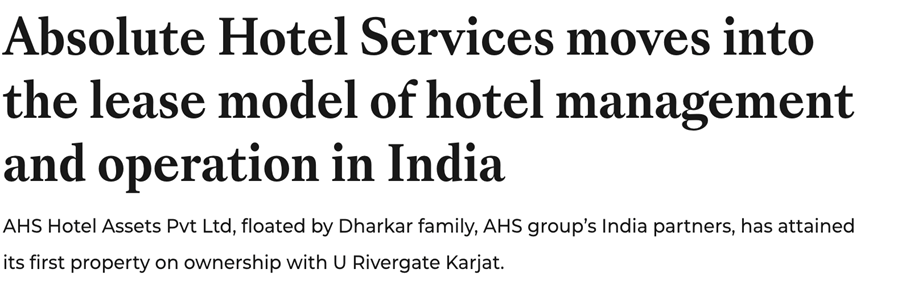
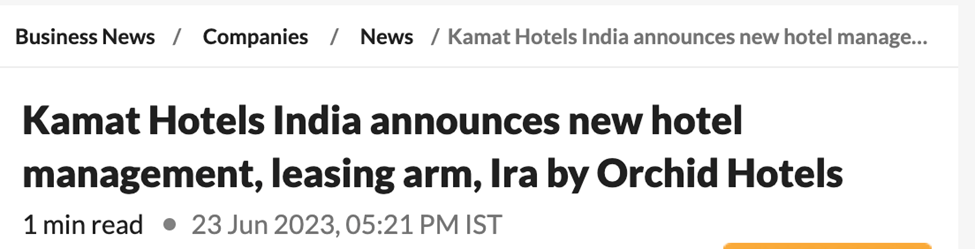
Data indicates that 40-50% of capital costs are allocated to building construction, with less spent on land and machinery. This suggests significant investment in infrastructure, such as constructing hotel rooms. And because of that Recently, there’s a shift towards Operation and Maintenance (O&M) models, with businesses preferring to lease existing buildings.
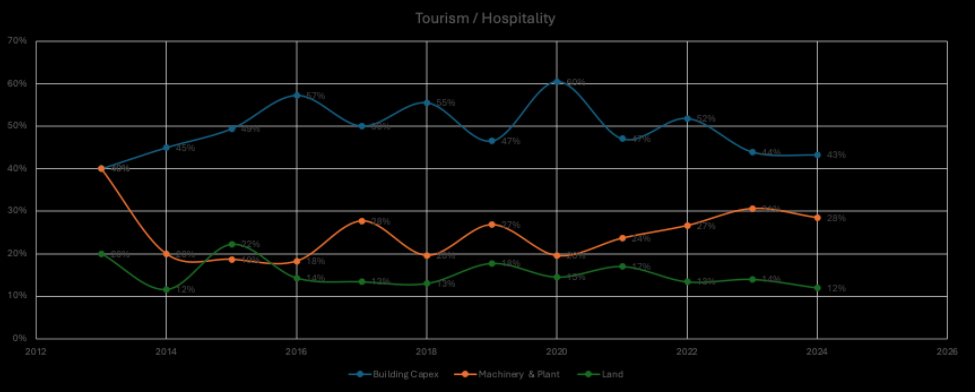
( For Representational purpose only)
Trend : This indicates that major investments are in infrastructure, such as constructing hotel rooms and facilities. However, a shift is observed towards operational models where businesses prefer to lease existing buildings rather than invest in new construction.

Information Technology (IT) Sector:
In Punjab, around 50% of capex is
dedicated to building infrastructure and 44% to machinery.
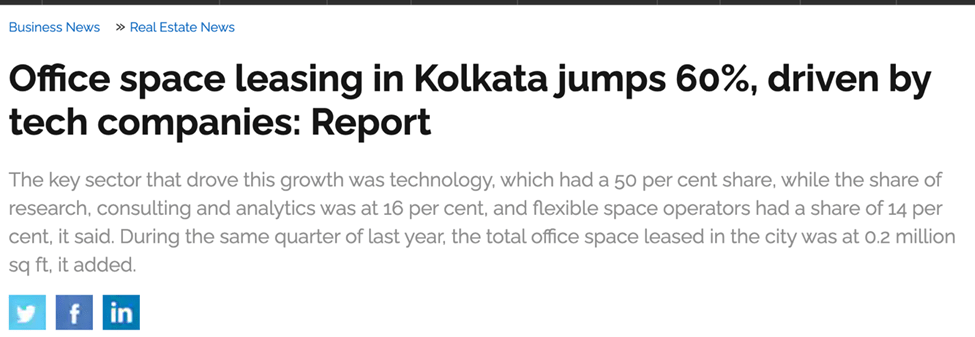
Decreasing land and building costs suggest a preference for leased office spaces over new constructions.
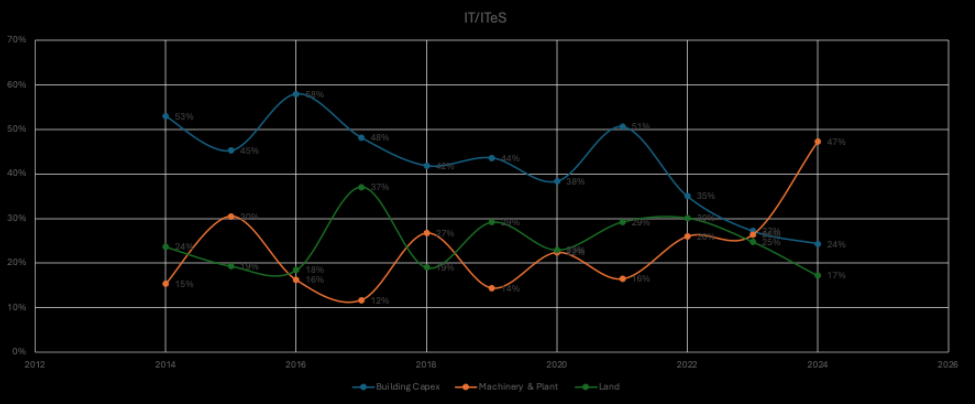
( For Representational purpose only)
Policy Implications
Governments can use this data to form targeted investment policies:
For the Hospitality Sector:
For the Hospitality Sector:
1.Building Cost Subsidies: Provide subsidies specifically for building costs to increase industry supply and optimize subsidy allocation.
2.Promote O&M Models: Encourage large brands to adopt O&M models by offering tax rebates and other incentives.
For the IT Sector:
1. Infrastructure Development: Invest in or incentivize local developers to create office spaces, attracting IT companies looking for leased office options.
2. Leasing Incentives: Offer tax incentives to IT companies that prefer leasing, aligning with industry trends.
Strategic Focus: Capital-Intensive vs. Labor-Intensive Industries:
Governments often equate economic growth with high capital investment, assuming it leads to job creation. However, distinguishing between capital-intensive and labor-intensive industries is crucial:
Capital-Intensive Industries: Require significant investment but generate fewer jobs. The capex per capita ratio helps identify these industries.
Labor-Intensive Industries: Have lower entry barriers and higher job creation potential. Focusing on these industries can enhance employment rates.

( For Representational purpose only)
Geographical Necessities :
Governments should judiciously allocate fiscal incentives, considering the nature of the businesses:
Consumer-Oriented Sectors: Industries like healthcare, retail, and logistics, Cement which need geographical presence in a market , might not require fiscal incentives or the state doesn’t need to provide them incentives , because they will be near the consumption centers always to drive business , they mostly don’t have any other choices . Redirecting these funds can result in significant savings and more strategic economic development by deploying these funds in other priority sectors .
By leveraging capex data, IPAs can craft targeted investment promotion strategies that align with industry trends and economic goals, ensuring sustainable growth and optimal resource utilization.
Data is all around us , you need to look at the right place and make sense of it .
Written By: Ankur Kushwaha, Sr. Consultant, Invest Punjab | Govt. of Punjab.
DISCLAIMER: Views expressed are personal.
 Invest Punjab Blogs