
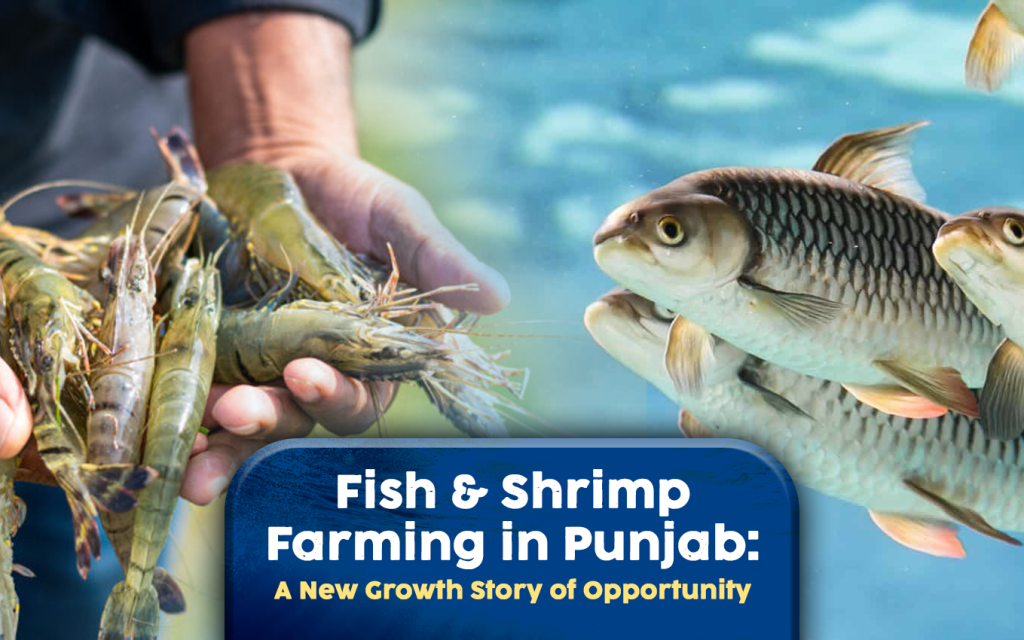
Punjab, long known as India’s agricultural powerhouse, is now witnessing a quiet transformation through fish and shrimp farming. What was once considered a non-traditional activity is today emerging as a high-potential, income-generating sector—especially in areas where conventional farming is no longer viable.
Turning Problem Land into Profitable Assets
One of the biggest advantages of fish and shrimp farming in Punjab is the use of saline and waterlogged land. Large areas in south-west Punjab were earlier unfit for agriculture due to high salinity and waterlogging.
- Shrimp farming has converted non-productive land into income-generating farms
- Even one acre of pond farming has shown high production levels (around 4 tonnes)
- This creates value from land that otherwise had zero economic return
High Income and Profit Potential
Fish and shrimp farming offers significantly higher returns compared to traditional crops:
- Farmers can earn around INR 3 lakh+ per acre from shrimp farming
- Shrimp fetches strong market prices, often INR 300–450 per kg
- Short crop cycles (as low as 3–4 months) allow multiple income cycles in a year
This makes aquaculture one of the most profitable diversification options for farmers.
Employment Generation and Rural Growth
The sector is not just about farmers—it creates a complete rural economy:
- Shrimp farming generates large-scale employment across the value chain
- Around 30 jobs per hectare can be created with expansion
- Activities like feed supply, transport, processing, and marketing create additional livelihood opportunities
It is a strong driver of rural employment and entrepreneurship.
Rapid Growth and Future Expansion
Punjab’s aquaculture sector is growing quickly:
- Shrimp farming has been expanding steadily since its introduction in 2016–17
- Production is increasing year-on-year with rising farmer participation
- The sector is growing at ~30% annually in northern states
There is still a large untapped potential, with thousands of acres of suitable land yet to be utilized
Shrimp and fish have strong domestic and international demand:
- Shrimp is a major export-oriented product with high global demand
- Fish consumption in India is rising, creating steady domestic markets
- Value-added products (fillets, processed fish, frozen shrimp) open new business opportunities
This ensures assured market linkage and better price realization.
Scientific and Technology Support
Punjab is actively promoting modern aquaculture:
- Scientific farming of species like Litopenaeus vannamei (white shrimp) has improved productivity
- Advanced systems like biofloc and RAS improve efficiency and reduce water use
- Government and institutions provide training, technical guidance, and support
This reduces risk and makes aquaculture more accessible even to new farmers.
Sustainable and Resource-Efficient Farming
Fish and shrimp farming also support better resource utilization:
- Efficient use of waterlogged and saline resources
- Lower dependence on traditional crops like wheat and paddy
- Potential to improve water quality and ecosystem balance in some systems
It aligns well with Punjab’s need to diversify agriculture sustainably.
Strong Government Push and Policy Support
The sector is backed by proactive policy support:
- Subsidies for pond construction, infrastructure, and inputs
- Promotion under fisheries schemes and “Blue Economy” initiatives
- Cluster-based development and training programs
These initiatives are encouraging more farmers to shift towards aquaculture.
A High-Potential Sector for Punjab’s Future
Fish and shrimp farming in Punjab is more than just an alternative—it is becoming a mainstream, high-growth sector.
In simple terms, its advantages are clear:
- Turns unused land into productive assets
- Provides high income in short time
- Creates jobs and rural businesses
- Offers strong market demand and export potential
- Supported by technology and government policies
Punjab is gradually moving from being just the “grain bowl” of India to also becoming a hub for aquaculture and blue economy growth.

