
For a decade, India’s logistics story was about building capacity: highways, freight corridors, terminals and warehouses. It is noted that the shift now is from capacity to flexibility. Shippers want networks that can absorb volatility, switch modes, scale space up or down and deliver predictably.
This blog explains what that shift means, what flexible logistics needs, and why Punjab, at the junction of North India’s freight flows, is well placed to deliver it.
What the shift looks like
Industry leaders describe the change clearly. Capacity planning has moved from “cover the peak” to “run for consistency”, and flexibility now outweighs centralisation because volatility is structural, not seasonal (ITLN). Grant Thornton calls it a shift from capacity creation to system effectiveness: the next phase depends on how well assets are planned, connected and run (Grant Thornton).
Demand is driving it. E-commerce and quick-commerce firms such as Amazon, Flipkart, Meesho and Blinkit have pushed logistics providers to treat speed, flexibility and visibility as core capabilities (Indian Infrastructure). As Maersk’s Girija Shanker put it, customers are not buying transport, they are buying certainty (Air Cargo Week).
India starts from a stronger base than once believed. The first official assessment by DPIIT and NCAER put logistics costs at Rs 24.01 lakh crore, or 7.97% of GDP, in 2023-24. That compares with the 13–14% figures long quoted from partial data (PIB). The same report put Indonesia at 24%, China at 14.4% and South Korea at about 8% (Millennium Post).
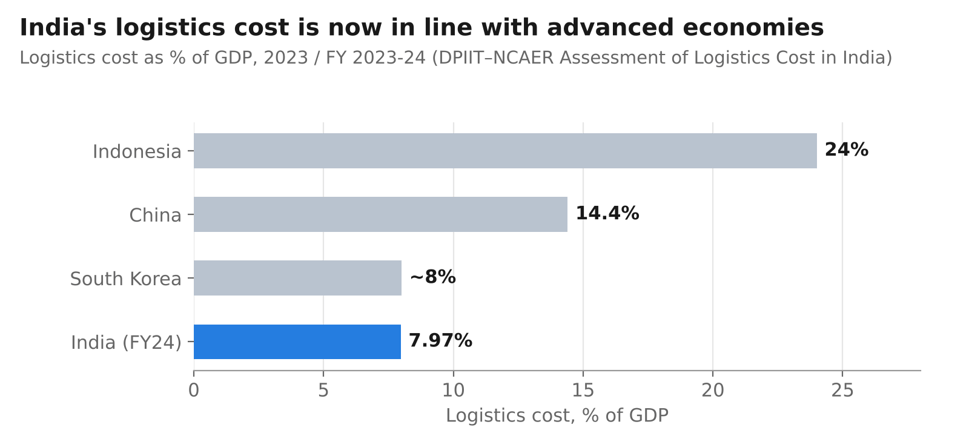
Figure 1. Logistics cost as a share of GDP. Source: DPIIT–NCAER, Assessment of Logistics Cost in India, via PIB and Millennium Post.
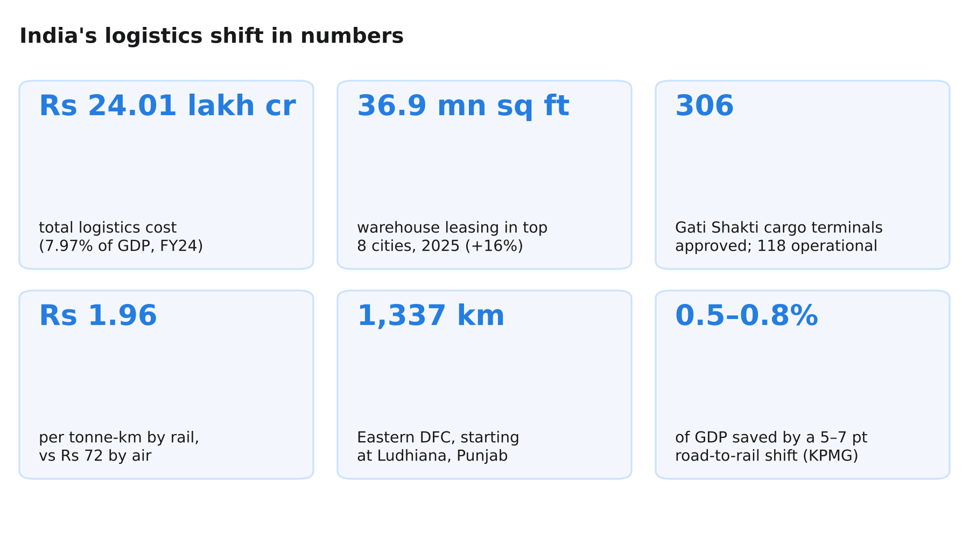
Figure 2. India’s logistics shift in numbers. Sources: PIB, Colliers, KPMG, Outlook Business, DFCCIL.
Five capabilities that define flexible logistics
1. Real choice between modes. Rail costs about Rs 1.96 per tonne-km against Rs 72 by air (Outlook Business). Indian Railways has approved 306 Gati Shakti Multi-Modal Cargo Terminals, 118 of them operational (KPMG). KPMG estimates that shifting 5–7 percentage points of freight from road to rail could save 0.5–0.8% of GDP (KPMG).
2. Warehousing that scales. Leasing in India’s top eight cities hit a record 36.9 million sq ft in 2025, up 16% (Colliers, via Open). The next step is models that let companies scale space up or down without carrying the full fixed cost of a dedicated facility (NewsX).
3. Regional distribution nodes. Flexible networks rely on hubs close to consumption and production centres, beyond the big metros.
4. Digital visibility. Integration with PM Gati Shakti, ULIP, FASTag and e-way bills, plus warehouse and transport management systems, IoT and analytics, turns physical assets into a responsive system.
5. Speed of setting up. Land, approvals and power must move as fast as demand. States that cut set-up time win the next wave of logistics investment.
Why Punjab is North India’s logistics gateway
Punjab sits between the NCR markets, the hill states and the western export corridors. It moves freight for regional distribution and long-haul trade alike, linking manufacturing, agri-value chains, warehousing and distribution.
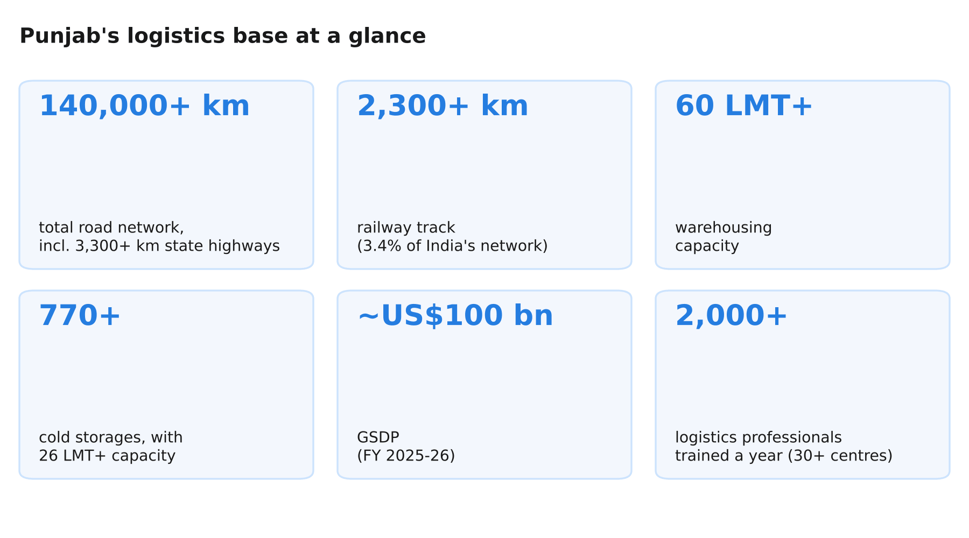
Figure 3. Punjab’s logistics base at a glance.
1. Where the Eastern Dedicated Freight Corridor begins. The 1,337 km Eastern DFC runs from Ludhiana to Sonnagar in Bihar and is now fully commissioned (DFCCIL). It cuts freight journey time on the route from 35–50 hours to 18–20 hours (Railway Journal). DFC trains run at 75–100 km/h, carry 5,300–13,000 tonnes per train and lower freight costs by about 5%.
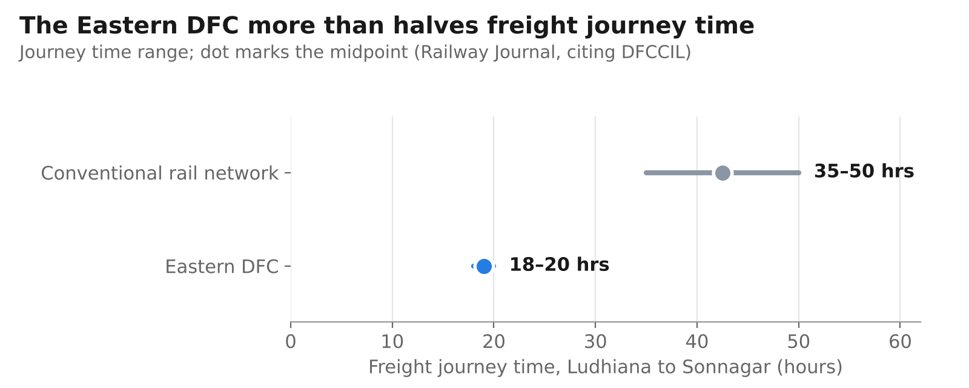
Figure 4. Freight journey time, Ludhiana to Sonnagar. Source: Railway Journal, citing DFCCIL.
2. A multimodal network already in place. Punjab has 5 Inland Container Depots, 3 Multi-Modal Logistics Parks in Ludhiana (CONCOR, Hind Terminal and Adani Logistics), 3 Integrated Check Posts at Attari and Dera Baba Nanak, 2 air cargo complexes at Amritsar and Mohali, 2 private freight terminals and 5 dry ports. The state was rated a Fast Mover in the LEADS 2024 logistics index.
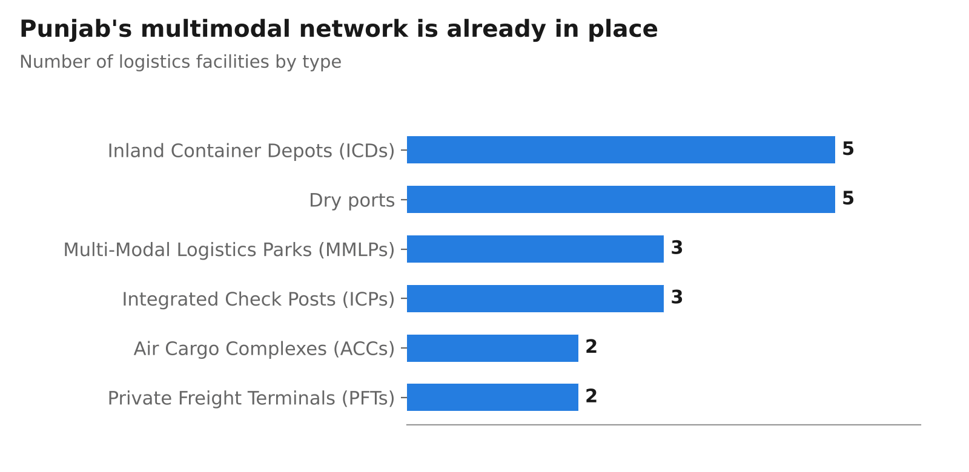
Figure 5. Punjab’s logistics facilities by type.
3. Corridors in every direction. The Amritsar–Kolkata Industrial Corridor (AKIC) runs through Rajpura, Sirhind, Doraha, Sahnewal and Ludhiana. State corridors link Chandigarh with Amritsar, Hoshiarpur–Gurdaspur and Patiala–Sangrur–Bathinda. Major road projects are adding capacity:
| Upcoming corridor | Punjab districts crossed |
| Delhi–Amritsar–Katra Expressway (greenfield, access-controlled) | Patiala, Sangrur, Barnala, Ludhiana, Jalandhar, Kapurthala, Amritsar, Gurdaspur |
| Amritsar–Jamnagar Economic Corridor (Bharatmala) | Amritsar, Tarn Taran, Ferozepur, Faridkot, Muktsar, Bathinda |
| Punjab Expressway, Chandigarh–Bathinda (proposed greenfield) | SAS Nagar, Fatehgarh Sahib, Barnala, Mansa, Bathinda |
| Ludhiana–Rupnagar Expressway (NH-205K) | Ludhiana, Fatehgarh Sahib, Rupnagar |
| Ambala–Ludhiana greenfield corridor | SAS Nagar, Fatehgarh Sahib, Ludhiana |
| Zirakpur bypass (6-lane, access-controlled) | SAS Nagar (Zirakpur) |
| Pathankot–Mandi / Pathankot–Kangra NH upgrades | Gurdaspur, Pathankot, Hoshiarpur, Rupnagar |
Table 1. Major upcoming road corridors through Punjab.
4. Anchor nodes with room to grow. The Integrated Manufacturing Cluster at Rajpura spans 1,099 acres at the junction of NH-44 and NH-64. It has an investment potential of Rs 7,500 crore and is expected to create over 64,000 jobs (NICDC). Around it, distinct logistics markets are taking shape:
- Ambala–Rajpura belt: a key de-consolidation point for North India, serving tier-2 cities, Himachal Pradesh and J&K. Demand comes from FMCG firms such as HUL, P&G and PepsiCo, 3PLs such as Mahindra Logistics and XpressBees, and e-commerce. The NH-44 cluster posted 25% leasing growth in 2024, with vacancy below 10%.
- Ludhiana belt: Punjab’s premier industrial hub, on NH-44, NH-5 and NH-1 and at the head of the EDFC. Its stock is 80% Grade-B, serving apparel, auto components, bicycles, hosiery and FMCG. Leasing dipped 9.6% in 2024 to 0.42 million sq ft as e-commerce slowed, but the NH-44 micro-market gained share. The EDFC is expected to drive modern, higher-grade parks.
- Zirakpur–Mohali: an emerging regional distribution node and a gateway for NCR–Himachal–Punjab freight.
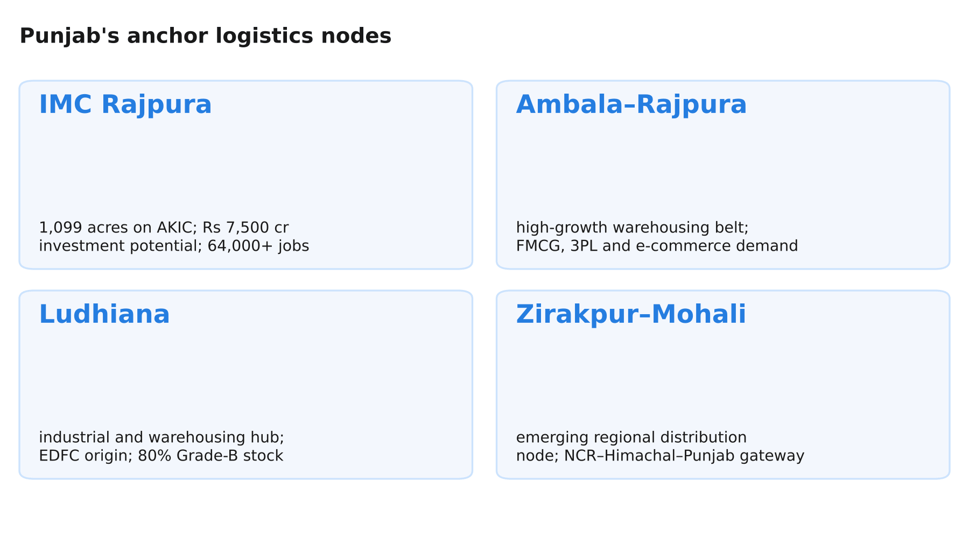
Figure 6. Punjab’s anchor logistics nodes. Source for IMC Rajpura: NICDC.
5. Cost and talent. Office rents and salaries in the region are about 25% lower than in Delhi or Bengaluru (Gulf News). About 70% of Punjab’s population is of working age, and 30+ logistics training centres train 2,000+ professionals a year. The state’s GSDP is about US$100 billion (FY 2025-26), and it was recognised as a Leader State in the Export Preparedness Index 2024.
A policy built for logistics investors
Fiscal incentives. Under the Industrial and Business Development Policy (IBDP) 2026, warehousing and logistics units can receive up to 100% of eligible fixed capital investment, capped at Rs 500 crore. Logistics parks, MMLPs and cold-chain facilities get a 20% capital subsidy, up to Rs 10 crore. Units choose an incentive period of 10–15 years.
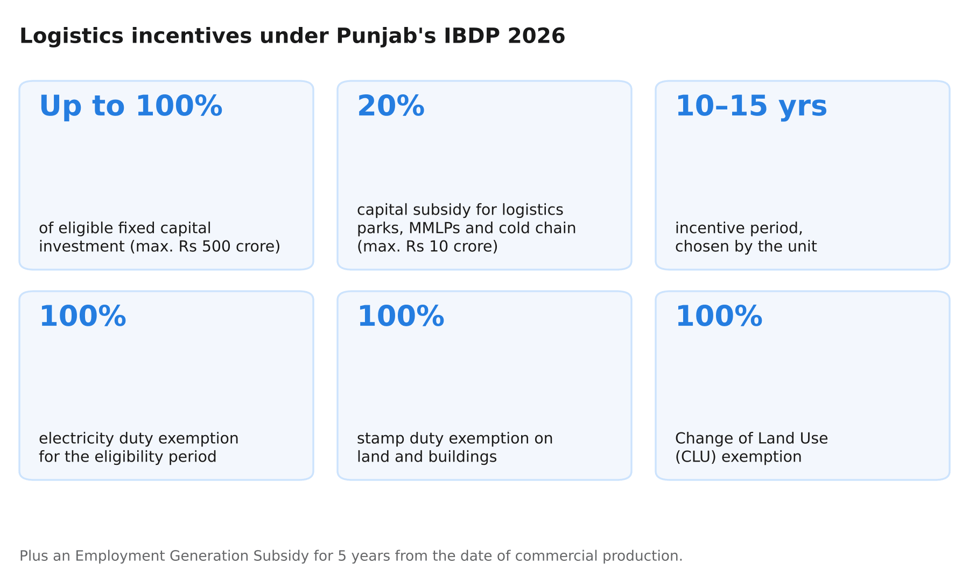
Figure 7. Logistics incentives under Punjab’s Industrial and Business Development Policy 2026.
Non-fiscal support under the Logistics Sectoral Policy 2026:
- Land and building norms: 65% ground coverage (plus 5% purchasable), a base FAR of 1.30 and no height limit beyond airport clearance. At least 10% of land (or 10 acres) in every new industrial park is reserved for logistics, with truck parks and wayside amenities along freight corridors.
- Power: electricity-duty approval within 7 working days, a higher small-load limit of 50 kW, renewable installations up to 125% of load and time-of-day tariffs with Rs 2/unit off-peak rebates.
- Labour: 24×7 operations in three shifts, overtime of up to 144 hours a quarter, night shifts for women with safety arrangements, and a single registration, licence and return.
- Environment: deemed approvals for consent to establish and operate, and self-certification for low-risk units.
- Digital: a GIS-enabled warehouse dashboard on the single-window portal, and integration with PM Gati Shakti, ULIP, FASTag and e-way bills.
Approvals with deadlines. Under the Right to Business (Amendment) Act 2025, in-principle approval comes within 5 days inside industrial parks, 15 days for new units outside them and 18 days for expansions. Approvals are deemed granted if timelines lapse. The FastTrack Punjab Portal offers 200+ online services with a single entry and exit, a maximum of 45 working days, and India’s first digital revenue feasibility certificate in 15 days. Invest Punjab acts as one regulator across 20+ departments: one office, one officer and one portal. Punjab was named a top achiever in five ease-of-doing-business pillars in 2025.
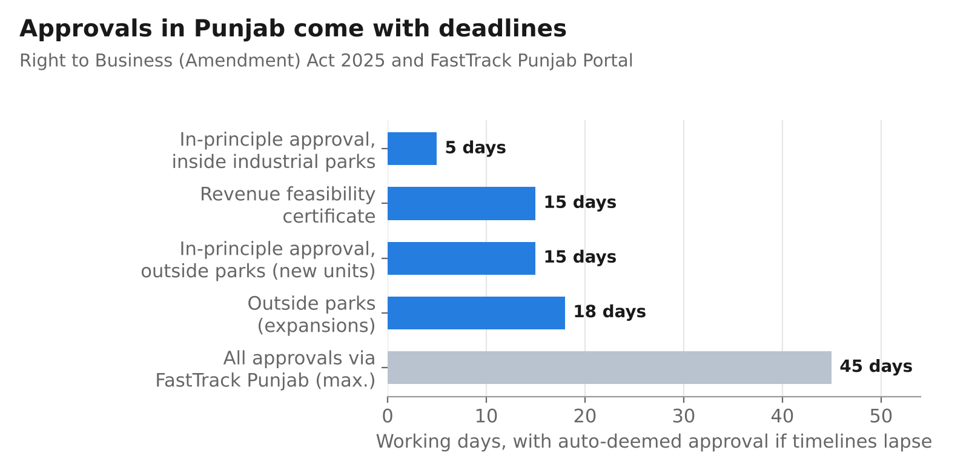
Figure 8. Approval timelines in Punjab.
Investment opportunities
Punjab’s logistics opportunity spans eight segments: logistics parks and hubs, warehousing and storage, cold chain, last-mile delivery, green logistics, reverse logistics, freight transport infrastructure, and digital logistics and supply-chain technology. Priority locations include:
- Zirakpur–Tepla–Rajpura hub: a proposed industrial logistics and warehousing hub that can become the primary node for freight from Shimla, Baddi, Delhi and Punjab’s industrial belt.
- Grade-A warehousing in Ludhiana and the Ambala–Rajpura belt, to upgrade a largely Grade-B market as the EDFC drives demand.
- Cold chain for Punjab’s agri and food-processing base, building on 770+ cold storages.
- Dry ports and rail-linked parks at Amritsar (Chheharta), Mohali (Dappar), Jalandhar, Ludhiana and Bathinda.
- Logistics-tech in warehouse and transport management, IoT tracking and automation.
The bottom line: India’s logistics advantage will come from flexibility: the ability to switch modes, scale space and deliver with certainty. Punjab sits at the head of the Eastern DFC, on the AKIC and new expressways, with a multimodal network, generous incentives and approvals with deadlines. It is ready to be North India’s flexible logistics gateway.
Planning a logistics or warehousing investment? Connect with Invest Punjab: investpunjab.gov.in.
References
- ET Supply Chain – India’s logistics shift is moving from capacity to flexibility
- ITLN – How India’s logistics networks are being rebuilt for 2026 and beyond
- Grant Thornton Bharat – Transforming India’s logistics ecosystem
- Indian Infrastructure – Big shift: evolving logistics supply chain models (Feb 2026)
- Air Cargo Week – The hidden costs of inefficiency
- NewsX – India’s logistics infrastructure is scaling fast
- PIB – Report on Assessment of Logistics Cost in India (DPIIT–NCAER)
- Millennium Post – India’s logistics cost estimated at 7.97% of GDP in FY24
- Outlook Business – India’s logistics cost pegged at 7.97% of GDP
- KPMG – Rail versus roads: rebalancing India’s freight mix (Apr 2026)
- KPMG – Logistics costs to GDP: can Budget 2026 move the needle?
- Open – Delhi NCR, Chennai lead India’s industrial leasing boom in 2025 (Colliers data)
- DFCCIL – Eastern Dedicated Freight Corridor milestones
- Railway Journal – India’s Eastern Dedicated Freight Corridor completed
- NICDC – Integrated Manufacturing Cluster, Rajpura-Patiala

