
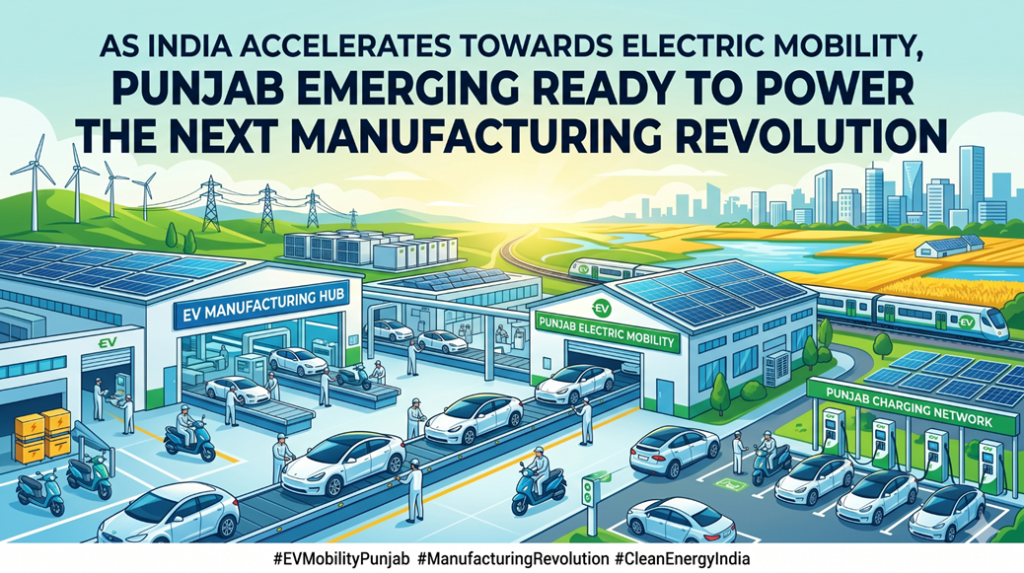
At a time when global energy markets remain uncertain and nations are rapidly moving towards cleaner transportation systems, India’s EV transition is no longer just an environmental agenda, it is becoming an economic and industrial transformation.
And in North India, Punjab is quietly preparing to play a defining role in that story.
For decades, Punjab has been recognised for its entrepreneurial spirit and manufacturing strength. From bicycles and auto-components to engineering goods and industrial machinery, the state has long powered India’s industrial economy. Today, those same capabilities are beginning to align with the next generation of mobility.
Across industrial clusters in Ludhiana, Dera Bassi, Jalandhar, Rajpura, Mohali, and Patiala, conversations are increasingly shifting from conventional manufacturing to electric mobility, battery systems, EV components, charging infrastructure, and clean transportation technologies.
The momentum is already visible.
Companies such as Hero Cycles and Avon Cycles are expanding into electric mobility segments. Emerging players such as Omega Seiki Mobility are exploring opportunities in Punjab, while manufacturers like JCBL Group and SML Isuzu are strengthening the state’s position in commercial and mobility manufacturing.
What makes Punjab particularly attractive in this transition is not just land or policy incentives, it is the ecosystem.
Punjab already possesses:
- a mature engineering base,
- skilled industrial labour,
- supplier ecosystems,
- logistics connectivity,
- and a culture of manufacturing entrepreneurship.
For EV companies looking to expand in North India, this creates a natural advantage.
As demand for EVs rises nationally, driven by government incentives, consumer awareness, fuel costs, and sustainability goals, the need for manufacturing capacity will grow exponentially. India will require:
- EV assembly units,
- battery pack manufacturing,
- charging equipment production,
- power electronics,
- fleet mobility solutions,
- and component ecosystems at scale.
Punjab sees this not merely as an industrial opportunity, but as the beginning of a new economic chapter. As EV demand rises nationally, Punjab sees a major opportunity to become a manufacturing backbone for North India’s electric mobility ecosystem.
The state’s strategic location further strengthens its position. Sitting at the gateway of North India, Punjab offers direct access to key markets including Delhi NCR, Haryana, Himachal Pradesh, Jammu & Kashmir, Rajasthan, and Uttar Pradesh. Strong road and freight connectivity make it ideal for logistics-heavy sectors such as electric mobility and commercial transportation.
At the same time, operational costs remain significantly more competitive than many Tier-1 industrial hubs.
This balance, industrial capability with cost efficiency is increasingly becoming Punjab’s core strength.
But manufacturing alone cannot drive the EV transition.
Charging infrastructure, grid readiness, battery recycling and urban mobility planning will define the success of electric mobility in the coming years and Punjab has been actively working towards it.
The state is also focusing on creating an investor-friendly environment through:
- single-window clearances,
- digital approvals,
- faster regulatory processes,
- and dedicated facilitation support.
Behind this policy push lies a larger vision:
to position Punjab as North India’s leading hub for sustainable manufacturing and future mobility.
The timing could not be more critical.
India’s transport sector is among the country’s largest consumers of fossil fuels and a major contributor to emissions. As the nation moves towards energy security and climate resilience, electric mobility will become central to economic policy, industrial investment, and urban development.
For Punjab, it also represents opportunity.
An opportunity to leverage its industrial DNA.
An opportunity to create new-age manufacturing jobs.
An opportunity to attract global and domestic investment.
And an opportunity to become a key contributor to India’s clean mobility future.
The EV revolution in India has begun.
Punjab intends to be at the forefront of it.

